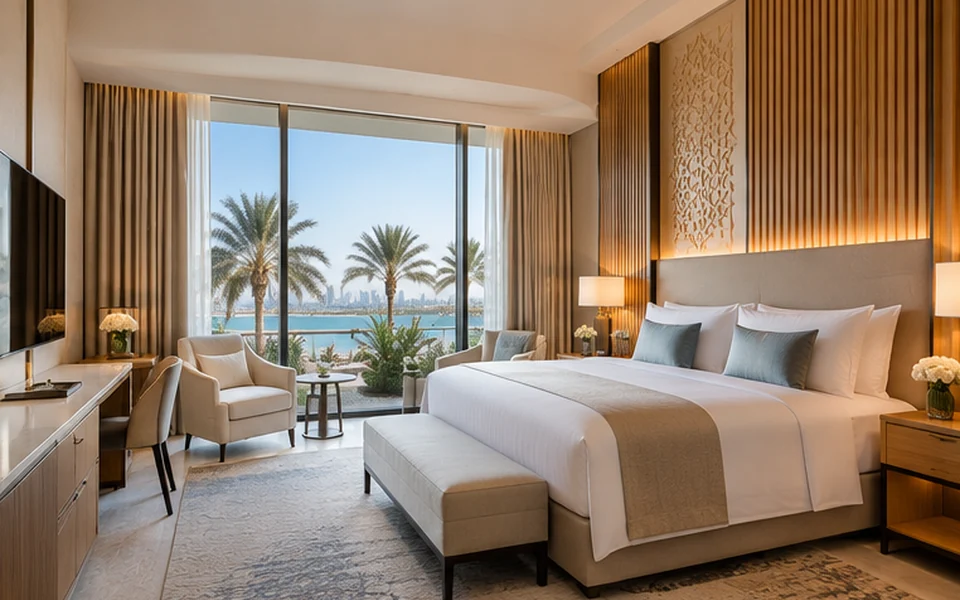
Guests may notice the view first, but they judge a hotel room by how easy it is to sleep, unpack, work and rest. A hotel interior design company in Hong Kong should evaluate light spill, noise, controls and housekeeping access with the same care given to the headboard and upholstery. Small spatial errors are repeated across every room key.
Guestroom design priorities for acoustic comfort, intuitive lighting, luggage storage and effective housekeeping.
Test the arrival with luggage and coats
Open the room door and consider where a guest stops, places a suitcase and hangs clothing. Furniture should not block circulation or reduce access to the bathroom. In compact guestrooms, clear floor space can feel more generous than an oversized feature chair. Position sockets and switches where people naturally need them rather than where a drawing looks symmetrical.
Coordinate sleep lighting and acoustic control
Provide an intuitive route from entry light to bedside reading and night-time wayfinding. Check light spill from bathrooms, electronic indicators and corridors. Review door seals, partitions and mechanical noise with the responsible consultants. Decorative wall panels can soften sound inside a room but do not replace appropriate acoustic separation between guestrooms.
Make technology simple and replaceable
Guests expect charging access, reliable connectivity and controls that work without instructions. Provide consistent control logic between room types. Avoid bespoke technology that cannot be serviced without dismantling furniture. Maintenance access to cooling and other equipment should be coordinated before a feature wall is approved.
Design for housekeeping and long-term renewal
Review bed clearance, stain resistance, upholstery maintenance, bathroom cleaning and replacement of high-wear parts. Select furniture dimensions that support safe movement and staff access. Document item codes so damaged fittings can be replaced consistently. A well-considered guestroom reduces friction for both guests and the operating team.
Example: a practical project decision
Example: A hotel planned a dramatic illuminated headboard. Guest testing showed its controls were confusing and the light could not be fully dimmed, so the system was simplified before manufacturing.
Putting this into practice
At the next review, ask the project team to walk the room with a full-size suitcase. The following discussion should address how to test every light from the bed and entry. Document the assumptions, responsible people and any unresolved questions before approving drawings or supplier orders. Before the next commitment, review sound insulation and mechanical noise and confirm cleaning and repair access around furniture. Where building management instructions, technical submissions or specialist work are involved, seek the advice of properly qualified parties. A useful decision record explains not only what was chosen but why, with any effect on budget, maintenance, user comfort or construction programme clearly stated.
A short decision checklist
- Walk the room with a full-size suitcase
- Test every light from the bed and entry
- Review sound insulation and mechanical noise
- Confirm cleaning and repair access around furniture
Frequently asked questions
What matters most in a small hotel room?
A comfortable sleeping environment, intuitive controls, storage and safe circulation typically outweigh decorative complexity.
Does luxury require elaborate technology?
No. Reliable and understandable technology often provides a better guest experience than complicated controls.
Continue reading
 Hotel Interior Design Company in Hong Kong: Mapping the Guest Journey
 Hotel Interior Design Company in Hong Kong: Flexible Breakfast and Lounge Areas
 Hotel Interior Design Company in Hong Kong: Refurbishment Without Losing Operations
 Restaurant Interior Design Company in Hong Kong: Acoustic Comfort for Busy Dining